
Mthuli Cameras And Accessories
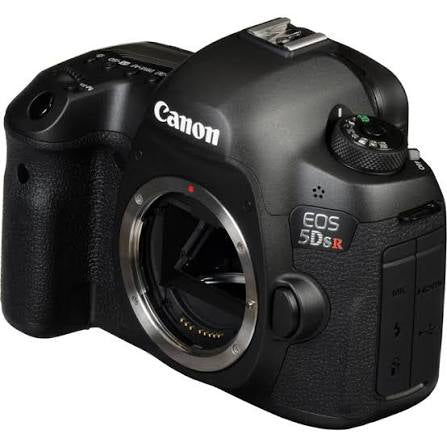
Canon EOS 5DS R DSLR BODY ONLY pre-owned
Canon EOS 5DS R DSLR BODY ONLY pre-owned
Couldn't load pickup availability
Shutterbug was fortunate enough to secure a loan of a pre-production version of the much-anticipated EOS 5DS R DSLR for testing and we were off and running with it as soon as it arrived. You’ve no doubt read our earlier report about this camera and its nearly identical twin the 5DS, each boasting a whopping 50.6MP full-frame sensor, which makes them the world’s highest resolution full-frame DSLRs
And undoubtedly your mouth started watering.
Face it, everyone is always clambering to buy the latest and the greatest, but you should also ask yourself, what will I use it for and what will it add to my photography? And perhaps the bigger question, is it time to switch (or switch back) to Canon?
Ever since medium format digital cameras and backs have been hitting us with pixel counts in the stratosphere, the DSLR world has been scrambling to catch up. But those medium-format backs have a purpose: they meet client needs, usually high-end advertising. And it’s not only the high resolution, which sits on a larger sensor, no less. These larger cameras also offer 16-bit color depth, in contrast to the 14-bit capture typically available to our higher-end 35mm style cameras. But there are many more applications that are not as demanding or that require high mobility, and that is where a 50MP DSLR will find its niche.
Here are the Canon EOS 5DS R’s key features and price:
• LPF (Low-pass filter) effect cancellation (in contrast to the EOS 5DS, which features a fully implemented LPF)
• Newly designed 50.6 Megapixel full-frame CMOS sensor
• EOS Scene Detection System with a 150,000-pixel RGB+IR Metering Sensor
• 61-Point High Density Reticular AF including up to 41 cross-type AF points and EOS iTR (Intelligent Tracking and Recognition) system
• Advanced mirror control mechanism and new user-selectable shutter release time lag
• Anti-flicker
• Built-in intervalometer and bulb timer
• 1.3x and 1.6x crop shooting
• Intelligent Viewfinder II with approximately 100% viewfinder coverage
• Full HD 30p movie capability and Time Lapse Movie function
• High-speed continuous shooting up to 5 fps
• 3.2-inch ClearView II LCD monitor, 170° viewing angle, 1,040,000-dot VGA, reflection resistance with multicoating and high-transparency materials
• Customizable Quick Control Screen
• Support for USB 3.0
• $3899 street price (which is only $200 more than the 5DS)

EOS 5DS R vs. EOS 5D Mark III
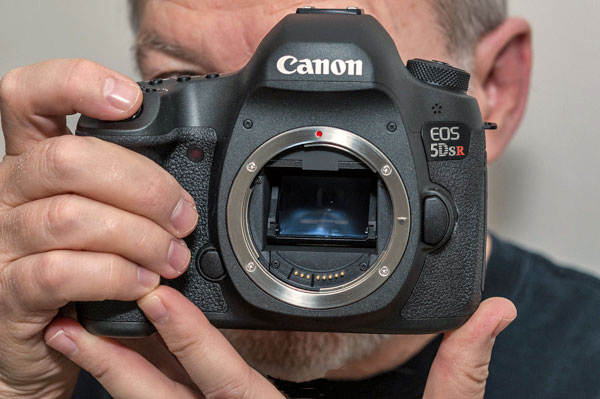
The Canon 5DS and 5DS R appear to be housed within the same chassis as the 5D Mark III. They’re the exact same size as their predecessor, although the new camera is a smidge lighter.
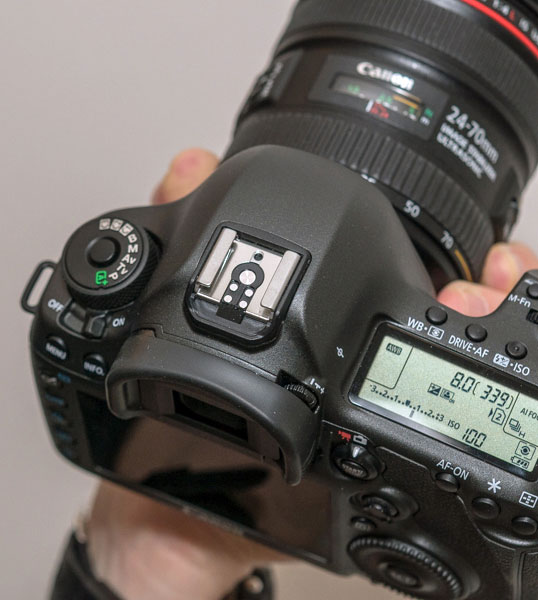
In fact, aside from some changes to the terminal compartments, which include elimination of the headphone terminal (the external mic terminal is still there), you’d be hard-pressed to see a difference on the surface, with what looks to be an identical control layout. That makes transitioning from the old to the new a piece of cake.
The only difference I can see, which is technically internal, is an improved electronic level in the optical viewfinder on the new camera. The electronic level is now a discrete display apart from the focus points.
Under the Hood
The substantive differences are under the hood. They obviously begin with an astounding 50.6MP sensor inside the Canon 5DS/R. The 5D Mark II, with its 22.3MP sensor, pales in comparison. Concomitant with that, Canon has discarded the Digic 5+ image processor and endowed the new cameras with dual Digic 6 chips for enhanced processing speed and image quality. And, of course, the 5DS R effectively lacks a low-pass filter (it’s not missing, just “effectively” nullified).
To take advantage of the Canon 5DS R’s increased resolving power, there’s a new Picture Effect (Fine Detail). Actually, it’s a refinement of current settings that increases and tweaks sharpness. Whereas the individual parameters for each Picture Style are set in camera, you can change the Picture Style as a whole during Raw processing in Canon’s Digital Photo Professional 4, which is much improved over previous releases. That post-processing option is not available for JPEG captures.
There’s also a new mirror vibration control system that very effectively dampens mirror noise and kick. As Canon explains it, “The camera's mirror is not controlled by springs but instead is driven by a small motor and cams. This system suppresses the impact typical of the camera's mirror.” You can also set a Time Release Lag for the mirror return to further quash the effect the mirror has on long exposures “by setting the shutter release time intentionally longer so the camera does not begin the exposure until after the impact of the camera's mirror has diffused.”
Another added feature lets you define a crop factor (1.3x or 1.6x) instead of simply choosing an aspect ratio (you can’t opt for both). The crop factor adds a frame to the viewfinder image outlining the cropped view (or you can think of it as displaying the magnified image). This can be undone/modified during RAW processing, regardless of which software is used, but is carved in stone in JPEGs.
Frame Rate and ISO
Here’s where you may be disappointed. Despite pumping up the volume with a new engine, that’s apparently not enough to fuel the Canon 5DS/R to deliver the same frame rates as the 5D Mark III. Frames per second (fps) drops to 5 on the new camera. Granted, we are dealing with much larger files, so perhaps we should be happy with 5fps.
However, there’s a flip side to frame rates but in a different sense. And that is that you can now shoot time-lapse movies in camera, in addition to the normal range of full HD movie shooting to 30p in full HD, 60p in HD. Sorry, still no 60p in full HD, but do you need it?
One noteworthy omission is support for 4K/UHD video. Perhaps that’s because Canon wants to steer videographers and filmmakers toward its pro video gear. Case in point, the new Canon XC10 (review to come).